


Indorca workers are the stuff of legend in Venezuela, but their experience teaches us that democratic self-management is a real possibility.
https://www.youtube.com/watch?v=t_7kNgvSHP4
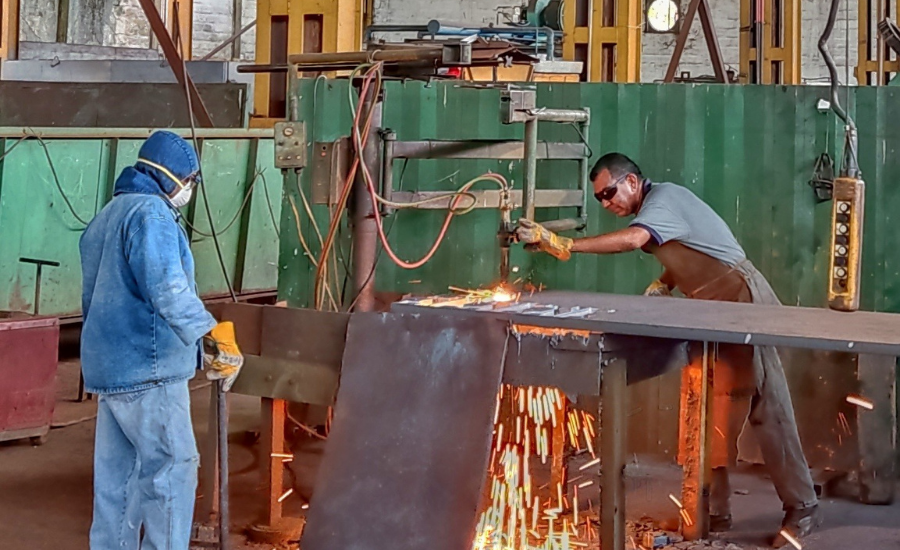
Progressive International || Industrias del Orinoco, C.A. (Indorca) is a factory without bosses in the industrial city of Puerto Ordaz in Bolívar state, the home of Venezuela’s basic industries. Indorca’s workers carried out a heroic three-year struggle to gain control of the factory after the former owner brought it to a halt. Since 2015, when Venezuela’s Ministry of Labor extended a mandate giving the workers control over Indorca, the enterprise has been democratically managed by the women and men who produce here day in and day out.
In Part I of this two-part interview, the workers of Indorca tell us about their fight to keep the former bosses from dismantling the factory and regaining control of the plant. In Part II we will learn about the struggle to maintain the factory afloat in a sanctioned country and also about Indorca’s educational initiatives.
A history of struggle: Indorca workers occupy the factory
After an owner-imposed lockout, Indorca’s workers organized a watch to protect the factory. They slept in the “maloca” [open-air structure with a roof and no walls] right outside the plant and they debated about a more democratic way of running things. They also mobilized so that the government would apply Article 149 of the Labor Law, which entitles workers to take control of an enterprise when the owner sabotages the production process.
Eliezer Perdomo: Indorca is a metallurgic workshop, built to serve the basic industries in Guayana [historic name used to refer to Bolívar state], from Sidor [state-owned steel production plant] to Venalum and Alcasa[both state-owned aluminum plants]. It was founded in 1976. The former owner was Oscar Jiménez Ayesa, a capitalist with both industrial and banking interests.
José Cedeño: Around 2010, when Chávez was trying to radicalize the Bolivarian Process, the first signs of an economic war against the Venezuelan people became evident. Here in Guayana, the bosses began to drag their feet in many privately-owned factories. They were remiss in paying workers’ benefits, began to make layoffs, and purposely generated supply-chain bottlenecks.
This was happening at Indorca as well, so we decided to organize a union in 2011. Needless to say, the bosses didn’t smile upon this process. They fired several organizers in the middle of a collective bargaining process, including me. The bosses also put a restraining order on us, and we were not allowed into Indorca’s perimeter. However, that didn’t hold us back: we continued the fight from the ropes.
Those were difficult times, but they were also beautiful: we were without jobs, but worker solidarity kept us alive, and we began to think about our potential as a class: if we produced the goods and the bosses were sabotaging the production, could we take over the process?
In 2012, just two months after the new Labor Law came into effect, the bosses shut down the plant. They were not the only ones to do this: other privately-owned factories closed shop as well. It was a coordinated sabotage effort driven by political objectives. The bosses didn’t want Chávez anymore, even though many had benefited from government credits and contracts for years.
When the owner declared bankruptcy and closed up shop in Indorca, it became clear that he also wanted to dismantle the plant. This had happened in other factories, and we were not going to let it happen here. That is why we set a 24-hour watch to defend the installations. We slept on pieces of cardboard and hammocks in the maloca, while eating the fruit we could gather and the iguanas we scavenged. However, we also got solidarity from the workers in other enterprises.
All the while, we began to think about a different production model that would be closer to us: if we took decisions in an assembly in the defense of Indorca, why couldn’t we collectively run the factory in an assamblearymanner? Things were not pretty, but we were learning a lot.
Meanwhile, the bosses introduced a lawsuit for trespassing private property against 20 workers, so we had to report to tribunals every two weeks for three years. The owner also sent the National Guard, the police, and the SEBIN [Bolivarian Intelligence Services] to harass us.
Levi García: As José said, we decided to organize a union in 2011; the existing one responded to the interests of the bosses. The workers’ union got the majority vote, and we began a collective bargaining process. We advanced in our negotiations, but when it got to the issue of economic incentives, the process came to a halt. Finally, the Ministry of Labor had to intervene and we reached an agreement. Shortly after, however, the company began to fire workers.
The bosses also tried to get some of us to collaborate in the process, which we obviously didn’t do. Eventually, they brought the factory to a halt. That is when we decided to organize to protect Indorca: we knew that if we didn’t do this, the owner’s men would dismantle the factory.
Finally, on March 23, 2015, we got control of Indorca: the Ministry of Labor recognized us as the legitimate administrators of the factory and applied Article 149 of the Labor Law.
Eliezer Perdomo: On July 30, 2012, the bosses dismissed all the workers, put them on a bus, and closed the factory. Those workers never got paid.
It was obvious that we had to protect the means of production so we set up a camp of sorts in the maloca. We had to sleep out in the cold and hunt our own food, but we were not going to let Oscar Jiménez have his way and dismantle Indorca.
We were penniless and tired, but we kept at it. Our esprit de corps was growing. It was then that we began to take decisions in a permanent assembly. We drew up a plan: some would be charged with protecting the plant, some would go to Caracas and make themselves heard, and some would sell raffle tickets to fund the struggle.
Levi García: The year 2013 was very difficult. We had no work and no income, and I remember that December was really hard because I had no money to get new clothes for my kids. However, the whole thing was also a wonderful learning experience. Mutual solidarity and fraternity emerged out of the vigil we carried out in the maloca.
Later, but still during the standstill with the bosses, we began to get some odd jobs. That meant that while things were difficult, we could bring something home.
Josefa Hurtado: Those years were really difficult: we had no salary, we had no work, but we were committed to going forward. The owner wanted us to fail, whereas we wanted to go on producing. In the end, we succeeded. It was us, the workers, who reactivated the plant. We did it without bosses and without engineers.
Victor Mujica: While we were doing our permanent guard to protect the plant’s assets, we received a lot of solidarity from workers in other factories, including Calderys, which was already under worker control. We also got support from Sidor workers and from workers in other companies. Our comrades sometimes got us odd jobs so that we would have some income. Class solidarity was very important.
Finally, in 2015, the government applied Article 149, which granted us control of the factory. When the Ministry of Labor applies Article 149, it opens the path toward worker control. First, a three-person junta is established with two representatives of the workers and one representative of the owner. Since the owner’s representative didn’t show up, we were entitled to fill the third seat with another worker representative. That is how we finally took control of Indorca.
The struggle to get there was a long one: almost three years defending the means of production – months sleeping outside, hunting iguanas, and being harassed by the police…
The struggle was worth it, but things were not easy after that. The owners’ thugs had removed the high-power cables and other machinery. We also had become a toxic example – because of our class victory – so it took us a while to get new orders. Finally, in 2016, we signed contracts with Venalum and Sidor.
José Cedeño: Indorca’s capacity for resistance became the stuff of myths in Ciudad Guayana [Puerto Ordaz]. We had it really hard – we were harassed and persecuted – but the most important thing is that we stayed together as workers. Why? Because we knew that Indorca was important for the basic industries and for the country.
When we were finally recognized under Article 149, we got control of the factory. Then we had to overcome other barriers, from economic to administrative ones. We knew how to produce, but the management side was all new to us. To register all our revenues and expenses we simply wrote them down in a notebook. In a monthly workers’ assembly, we took all important decisions, applying the democratic principles that we had learned under the maloca.
We also had to go out into the world to get new contracts. It wasn’t easy because we were in a kind of limbo as an enterprise that was neither private nor public. However, eventually, we got our first contracts. It was a three-year battle, but worth it!
Reactivation and democratic control
At Indorca, democratic control and collective management of a factory is not the stuff of a future utopia. Rather, the workers run the enterprise without bosses and take all important decisions in a monthly assembly where every worker has an equal voice and vote.
Democratic Control
José Cedeño: The government’s decision to apply Article 149 came when Jesús Martínez of the Jesús Rivero Bolivarian Workers University [worker-run university] was Labor Minister. His support for the process was fundamental.
When the ruling came, we had already decided that we would run the enterprise democratically. Although Article 149 establishes that a democratically-elected three-worker junta will be in charge of the company’s administration, in Indorca it is the assembly that has the last word.
During the three years in which we held down the fort, we learned about equality and solidarity. As welders, mechanics, and supervisors, we all went through the same hardships, and we took the important decisions together. Things were going to be different in the new Indorca! Equality wasn’t going to be just about decision-making, it would also be about wages… We would all get paid the same, and that’s the way it’s been until now.
Whereas private enterprises and even public ones don’t show their accounting to the workers, here we review our accounts collectively once a month. Every bolívar that has been debited or credited gets reflected on the whiteboard [in Indorca’s meeting room].
In our monthly assembly, we also talk about workflow; address any problem that we may be facing at a particular time; debate about whether to accept a contract or not; and decide our salaries based on projected expenses and revenues.
Victor Mujica: When Indorca was privately-owned, we were just expected to be at our posts for eight hours a day and work with blinders on. When Article 149 was finally applied, we had a lot of learning to do. Of those who remained in Indorca, the most qualified worker had a high-school degree, but that didn’t keep us from running the enterprise!
We had to learn about accounting (which we had been doing in a notebook!), and we had to learn how to do cost analysis: how many man-hours were needed to produce a product and what inputs would be needed, etc.
Jesús Varela: The new Indorca is in our hands. What does that really mean? We don’t just produce, we also control the production process. Before, as workers, we were throwaway assets. Now we don’t only produce value, we also understand the production cycle. We are our own bosses… and it works!
Of course, this doesn’t mean that it was easy once Article 149 came into play. Learning the ins and outs of the management process doesn’t happen overnight.
Eliezer Perdomo: Here we take all decisions collectively: everything from monthly wages to how much money goes to maintaining the Indorca bus and how much liquidity should be kept in the bank.
For me, the most important thing about self-management is that we are not bossed around, and we can solve our own problems. There is no workplace exploitation or oppression. I feel free here. That never happened before, when Indorca was in private hands. All that makes my job much more enjoyable!
Yaneth Carreño: A democratic, self-managed enterprise is not a common thing in capitalism because it puts the worker at the helm.
I came to Indorca six years ago on a temporary agreement. I had just retired from a long career in public administration, and I was going to help put things in order here. When I first came, I sat down with the books where they kept track of expenses and resources available. I could see that the workers were very meticulous, but they needed accounting tools to keep their house in order.
Little by little, I became attached to Indorca. The solidarity, the relentless commitment to learning, and the democratic processes here were all new to me. But I learned something even more important: workers are the ones who produce value, they are the ones who produce the goods that Venezuela needs!
In our society, the factory worker is invisible. The boss, the manager, or the engineer may spend eight hours in an office, and he may even be tired at the end of the day. But what is that compared to the machine operator who is exposed to high heat and intellectual and physical exhaustion? Who but the worker thinks of viable alternatives now that the blockade makes it impossible to get certain inputs and parts? Who but the worker stays in the plant for long hours when an order is due?
There is this idea that factory workers do mechanical work that doesn’t demand intellectual effort. That is wrong! Industrial workers have to solve all sorts of problems, from mechanical to chemical and operational ones. On top of that, Indorca workers know about accounting and collective management.
I worked in public administration for 25 years, and I have learned more from the workers here than I did in my entire earlier career. My job here is humble: I work on the administrative side of the enterprise, and I help with the accounting. This boils down to carefully preparing for our monthly assembly where we review Indorca’s economic situation with a great deal of precision.
Cruz Gonzales: Jump-starting the new Indorca has been a beautiful experience. Even though things aren’t easy because of the country’s general crisis, working without bosses is much better. Now we all feel that we are an important part of the puzzle. We work hard, help each other out, and make decisions collectively.
I have learned a great deal here, and I want to go on learning. I have learned about welding, but I also understand more about accounting. Most importantly, I have learned about how to run an enterprise collectively and without bosses.
Jesús Varela: It is very common to say that workers cannot run factories. The Indorca experience shows the opposite: not only have we been at this for seven years, but whereas most state and privately-owned enterprises have shut down due to the crisis and the pandemic, we kept our doors open!
Orlando Pereira: As a worker, understanding what really goes on in the firm is empowering. We know what is in our bank account at any one time. We know the work that we have to do, and nobody bosses us around.
That doesn’t mean that this is a world without conflicts. We have disagreements, sometimes big disagreements. However, having the space to debate and figure things out together actually helps us smooth out the process. In many cases, debates can lead to finding better solutions to the problems we face.
Gladys Rangel: Equality is a real thing here in Indorca… We actually live by its rule! When I was hired some two years ago, I was interviewed by José and Yaneth. The first thing they said was that Indorca is not just any enterprise, that this is a democratically-run, self-managed factory, where all workers take decisions together in the monthly assembly, and that we all get the same pay. They also told me that I wouldn’t get rich, which is true [laughs].
Since then, Indorca has become my second home: I have raised my baby here and learned from the workers. Here I discovered how the working class can run a factory – even while Venezuela faces one of the hardest crises in its history!
Reactivating Indorca
José Cedeño: Once it became clear that we, the workers, were going to be able to take control of the factory, the owner sent his thugs and they took 80% of the high-power cables that fed the machinery. They also took tools, air conditioners, uniforms, measuring tools, and welding equipment. Beyond that, they broke the windows and destroyed as much as they possibly could.
That was very painful for us!
The same thing happened in Calderys and Equipetrol, two factories that had gone through the same process. We got together with them to evaluate the situation and we said: We have no money, but together we have a lot of acquired knowledge. Let’s jumpstart the three factories together!
What Indorca needed and Equipetrol had, they shared with us. What Calderys needed and we had, we shared it with them. We also had some help from Alcasa, Venalum, and Sidor workers.
Our major bottleneck was re-activating the heavy machinery. To do so, Calderys was able to help us get 500 meters of cable. That is how, in one week, we were able to reactivate Indorca: a lot of hard work, a lot of solidarity… and of course, many years of experience put to good use!

Industrias del Orinoco, C.A. (Indorca) is a factory without bosses in the industrial city of Puerto Ordaz in Bolívar state, the home of Venezuela’s basic industries. Indorca workers carried out a heroic three-year struggle to gain control of the factory after the former owner brought it to a halt. Since 2015, when Venezuela’s Ministry of Labor extended a mandate giving the workers control over Indorca, the enterprise has been democratically managed by the women and men who produce here day in and day out.
In Part I of this three-part interview, the workers of Indorca told us about their fight to keep the former bosses from dismantling the factory and regaining control of the plant. Here, in Part II, we learn about the obstacles that worker-run factories face in a capitalist society and about Indorcas’ collective education projects.

Obstacles to worker control
Indorca workers have identified several obstacles that are particular to democratically-run enterprises. These obstacles are part of the complexity of building a socialist project embedded in a societal context in which capitalist relations still predominate. Part III of this series will address the impact of the blockade on Indorca and its production.
Jose Cedeño: Worker control goes against the grain and questions the logic of capital. It teaches society that workers not only produce value, but can also run a factory. Here, at Indorca, we have collectively identified five obstacles shared by all worker-run enterprises [in Venezuela].
The first obstacle is the legal one. In Venezuela, we have a powerful tool that allows workers to take control of a factory when the bosses are sabotaging production: Chávez’s 2012 Labor Law. However, when the workers are granted control of a factory [through article 149 of that law], we are left in a kind of limbo. We are neither “fish nor fowl”; neither a private enterprise nor a state-owned factory.
In our case, after three years of struggle, in 2015, we were granted control of the enterprise. However, it wasn’t until 2016 that we were able to sign our first contract with Venalum [an aluminum plant in Puerto Ordaz]. It took all that time to break down the legal barriers, and we had to do so creatively, by engaging a third party [a cooperative] to sign the contract.
There is another issue that has us worried. The Labor Ministry must renew article 149 every year. To comply, a worker-run enterprise has to turn in a yearly report, which we did in September 2021. Our concern is that the ministry has been remiss in renovating article 149 for Indorca and for other worker-run enterprises. This generates anxiety among the workers and it makes our [legal] standing with potential clients more precarious.
The second obstacle that we encounter relates to prices. Since most of our contracts are with state-owned industries, when orders are being discussed, the counterpart will sometimes allege that we are not charging them “socialist prices.” To state the obvious, socialism isn’t about low prices! Our prices are not higher than those of transnational corporations. We can’t offer lower prices either: transnational corporations enjoy economies of scale and engage in unfair competition. So beating their prices is almost impossible.
The third obstacle relates to a notion of “correctness” that, at the end of the day, is connected to our society’s hierarchical organization. When we finally got control of Indorca in 2015, all the engineers had left the enterprise, and we were running it democratically.
Collectively the workers have hundreds of years of accumulated experience, and we were able to keep the factory running during the hardest of times. Nevertheless, there were – and still are – people in the basic industries and oil sector who will not contract with us because we aren’t “qualified.” Little by little we have been able to overcome these prejudices, but we still encounter them from time to time.
There is a fourth obstacle: quality control. We adhere to ISO 9000 [quality control system]. Moreover, PDVSA’s affiliate INTEVEP [Venezuelan Technological Institute for Oil] audits us on a regular basis. Even so, we face all sorts of questioning by potential clients. Why? Once again, many don’t believe in democratic management.
The last obstacle relates to payment. When the state contracts a private enterprise, the bill is paid almost immediately. However, when they contract worker-run enterprises, they sometimes take one or even two years to pay. This kind of situation can become unsustainable, particularly in an inflationary context. I should say, however, that in the case of our latest contract, with Sidor [a steel plant in Puerto Ordaz], the payment was on time.
There are other obstacles that we have to overcome as a worker-run factory. When we took control of Indorca, all the bosses in Guayana’s private industries closed ranks with Oscar Jiménez Ayesa [the former Indorca owner]. These private industries service PDVSA and Guyana’s basic industries.
They used to contract with Indorca before 2012, when the struggle began, but they abruptly stopped. This is called class solidarity: they want us to fail because we are a “bad example” for the working class as a whole!

Dependency
Sergio Requena: When considering the hurdles we face, we should also reflect on the issue of dependency. In the global context, Venezuela never ceased to be a producer of raw materials.
When Chávez decided that the nation should take control of PDVSA and end its subordination to corporations of the Global North, that provoked a right-wing coup and then a sabotage of the oil industry. Although the nation succeeded at retaking control of PDVSA, these actions were a blow to the industry, and it came with a silent siege on PDVSA.
Later Chávez tried to promote the industrialization of Venezuela. He signed cooperation agreements with China and Iran. That resulted in the Yutong and Venmotor automotive projects and also the Vit and Vetelca technological enterprises.
These projects and others were efforts to break with dependency on the Global North. However, there was never a unified plan for industrialization, so we never delinked from the Global North and its dictates.
Indorca’s niche is servicing the basic industries. Yet the basic industries are linked to global value chains: they produce and export anything from pig iron to steel… However, Venezuela doesn’t produce finished products, which is what yields the largest profits.
That is a problematic situation in itself, but it also affects us downstream: if the basic industries are highly dependent on global value chains, that means that Indorca is too. Moreover, if the links to international markets suddenly break down – as has happened with the blockade – then the problems of dependency become intensified. As it turns out, our clients lost both their suppliers and their clients with the blockade. That meant that when their work came to a halt, ours did too.
To understand the complexity of Indorca’s situation, we have to understand global value chains, Venezuela’s highly dependent position in them, and the impact of the blockade on our sector.
The blockade is a grave problem, but the issue of dependency is there with or without sanctions.
Full Reactivation
José Cedeño: Indorca has the capacity to employ 200 workers. Now there are 40 workers in total in the areas of production, maintenance, and administration. Our current salary is 15 USD per week. However, we hope to be able to raise wages, as result of the latest Sidor contract.
Even so, a full reactivation is possible even in these times of imperialist blockade: we have a great deal of experience, and the services that we offer are needed for the reactivation of the basic industries. If that were to happen, we would be able to restore Indorca to 80% of its installed capacity.
Yaneth Carreño: There is a coordinated effort to reactivate the basic industries, and we celebrate it. However, while this is happening, we think that the managers of those industries should turn toward the factories under worker control. These democratically-run factories are up and running, thanks to workers who were committed to keeping the plants open and fought against the deindustrialization of Venezuela. It was a patriotic action!
Things are difficult here in Indorca. Our wages are low and our situation is precarious. Still, we are not beggars and are not asking for a handout from the government. What we are requesting is that our services be considered in preference to those offered by the private sector.
Victor Mujica: There is one additional caveat when it comes to getting contracts. Some operators prefer to contract with private enterprises – even if their quality is not up to standard and the costs are higher – because at Indorca we will not offer them kickbacks.
This happened in 2019. We got a job offer, but it came with a 10% under-the-table “tax.” As a worker-run factory, we are neither willing nor able to do that. Needless to say, we lost the bid.

Permanent education
The most important classroom for workers in Indorca is the weekly assembly where decisions are debated and taken democratically. However, more formal studies have also become important since they took collective control of the enterprise. The room where they study has Chávez’s eyes stenciled on the wall.
Sergio Requena: Collective education has been critical for the new Indorca and for two more worker-controlled factories here in Puerto Ordaz: Equipetrol and Calderys.
The Jesús Rivero Bolivarian Workers University [UBTJR, for its initials in Spanish] accompanied Indorca workers during the struggle and after they were granted control of the enterprise. The UBTJR implemented a multifaceted educational process. The foci included: thinking collectively about workers’ democracy and self-management; reflecting on the social labor process as it is organized in capitalist society; and projecting a new organization of the process in a socialist society. Those issues were all matters of concern to the workers, and they were all incorporated into a curriculum that was tailored for the struggle.
After the takeover, workers found themselves at the helm of an enterprise with a relatively complex administrative operation, but they had no experience with accounting and many other activities that took place in the offices. So, the UBTJR also offered tools to workers for bridging the “administrative gap.”
Finally, the educational missions also got going here in Indorca, from Robinson Mission [literacy] to Sucre Mission [university-level education].
For close to four years, the workers set aside two hours to study and debate. The debates were lively and the classes very dynamic. In this room where we are talking, we painted murals, with phrases from Chávez.
In effect, we set up a permanent workers’ university. If you had come here at 7 am or at 5 pm, you would have found forty workers trying to understand a Marxist category. Or maybe you would have run into three people learning how to read using the Cuban method. Perhaps an Indorca worker would be teaching other workers how to read a blueprint.
Josefa Hurtado: Our limited formal education didn’t keep Indorca workers from making many things that many engineers can’t make. However, when we took control of the factory, we also became aware that we had a huge responsibility. That is why we committed ourselves to collective education.
My education was cut short, since I was very young when I started to work. It was here, at Indorca, that I went through Robinson and Ribas Missions. I got my high school degree here at the factory.
Education and debate are priorities for us. That is why we all set two hours aside to study.
Yaneth Carreño: When I got to Indorca, the UBTJR and the workers had already begun a program involving political education and literacy programs.
I had never seen anything like it! Workers were teaching workers, preparing each other to democratically run the enterprise.
I was also surprised that Indorca’s permanent education project was actually fun. That has much to do with the experience-based method we employ. Our learning isn’t disengaged from our reality, and it isn’t top-down.

EDUCATION NOW
Sergio Requena: The Simón Bolívar Plan [2001-07] recognized that there can be no intellectual development unless the basic needs of the people are covered. Indeed, early on, Chávez deployed the nation’s resources to cover people’s basic needs. That, in turn, led to the project of making the “Whole Country into a School” [“toda la patria una escuela,” 2007].
In recent years, Venezuela has lived through a brutal shakeup. The multifaceted crisis and the sanctions have brought hunger back to the doorstep. Combined with the pandemic, this brought our active education processes to a halt.
The times are not easy! Yet there is still learning going on here at Indorca. A workplace that is not organized by the logic of capitalism is in itself a permanent school. Also, we recently started an apprenticeship program, thereby reinforcing Indorca’s vocation as a permanent school.
José Cedeño: A while back we looked at each other and we realized that we weren’t getting any younger. So we decided to begin an apprenticeship program to bring young workers on board.
The idea was to set up a one-on-one apprenticeship that will go hand-in-hand with workshops on how to read and interpret blueprints, the use of equipment for precise measurement, caring for machinery, safety procedures, etc.
But our objective is not simply to incorporate more machine operators. We want to prepare young workers so that they can identify a problem, for example, when an industrial lathe is not working or a piece is damaged. They should also be able to make replacement parts.
Moreover, we want to prepare youths to run an enterprise democratically. That is our ultimate goal. Teaching is really part of who we are.
Cruz González: I came to Indorca when I was 20 years old. My dad had taught me a few things about welding, but it was here that I learned the trade. Some time after I came to Indorca, my uncle, who also works here, took me under his wing and I became an apprentice machine operator.
I learned how to work and repair an industrial lathe. Now I can read a blueprint and cut a piece with millimetric precision.
I have learned a great deal here… In fact, I have learned two trades! However, the most important thing I have learned here is comradery and workers’ solidarity.
Jesús Varela: We consider Indorca a teaching factory. If we had to, we could even build a tank here! Our doors are open to anyone who wants to learn.

Discover more from Class Autonomy
Subscribe to get the latest posts sent to your email.


