

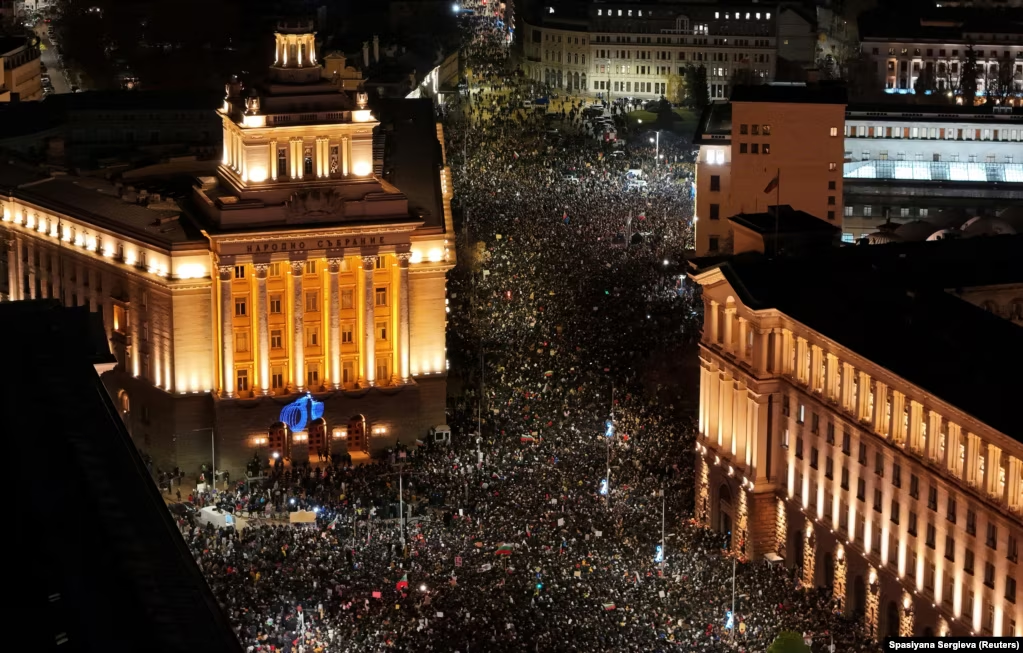
Mass protests in Sofia and other Bulgarian cities against the ruling coalition’s budget plans forced the government to backtrack on a bill that would have increased individual contributions to pensions and social security programs.
Camilo Márquez, Política Obrera via Freedom News || The demonstrations were organised by opposition parties against neoliberal measures that lack broad public support: “The budget bill included tax and pension increases and greater borrowing to finance public spending” (La Nación, December 2). It projected a 3% deficit and a minimum wage of €620 per month.
President Rumen Radev has held office since 2017 with limited powers in foreign policy and defence. Real power rests with the head of government, Prime Minister Rosen Zhelyazkov, a member of the Citizens for European Development of Bulgaria (GERB) party, who assumed office on January 16, 2025. The government is a fragile and highly divergent alliance comprising the pro-European Union centre-right, the pro-Russian Bulgarian Socialist Party, and another nationalist-leaning party.
This Frankenstein coalition is the latest experiment aimed at putting the country back on track after a prolonged period of political instability. Bulgarians have gone to the polls seven times since 2021 to elect a parliament that has been paralysed by a succession of coalitions led by various centre-right and right-wing parties.

“The scale of the December 1 demonstrations surprised everyone. Unusually, they were not confined to Sofia. Crowds gathered in numerous towns and cities across Bulgaria.” (Reporteri 2/12). Several factors appear to have contributed to Bulgaria’s decision to adopt the euro on January 1st, though this remains to be seen, “The coming months are extremely important for Bulgaria’s political direction,” stated the prime minister, who warned that “the adoption of the euro is not guaranteed,” reports the Bulgarian newspaper, The Telegraph.
The potential entry into the common zone has sparked fears among the population of the Balkan country of a sharp rise in prices. Bulgaria is the poorest country in the European Union and ranks second in corruption, only behind Hungary.
This year, Bulgaria joined the Schengen Area, a European zone of free movement of people without internal border controls between member countries. With European rearmament, this area has a military counterpart: a “military Schengen,” whose objective is to facilitate the free movement of troops and equipment throughout the bloc, particularly eastward, as a contingency plan against Russia. Beneath the surface of this integration, a fierce battle is being waged for the spoils of Ukraine between France, Germany, and Poland.
The latter is driving the so-called “Three Seas Initiative,” which connects the territories between the Baltic, Adriatic, and Black Seas, where Bulgaria plays a key role. Warsaw’s aim is to use this lever to facilitate the extraction of Ukrainian wealth across this vast territory and, at the same time, to lead the costly plan to “contain” Russia, bypassing and opposing France and Germany. Moscow has already labelled this ostensibly economic “initiative” as a series of military logistics projects hostile to its interests.
The country’s president, the pro-Russian Rumen Radev, called for the government’s resignation and new elections during the protests. The government was forced to abandon the draft budget the morning after the protests.
All of Eastern Europe is on the front lines of this conflict.


Discover more from Class Autonomy
Subscribe to get the latest posts sent to your email.