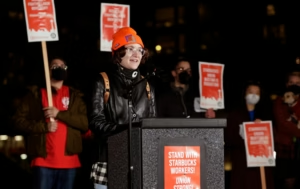
While the bought-off middle class was enjoying their bread-and-circuses fireworks spectacles, hundreds of Londoners who retain an ethical core yet spent the night demonstrating solidarity with Palestine Action UK hunger strikers at Pentonville Prison.
In keeping with the spirit of the Stupid Season, demonstrators reported excessive policing from a power structure that needed to look like it was in control of anything really.
Freedom News, legit the source for all thing anarchy || The traditional anarchist New Year’s Eve gathering outside HMP Pentonville was joined on December 31, 2025 by a solidarity demonstration for remand prisoners currently on hunger strike, organised by Palestine Pulse alongside other grassroots groups.
Hundreds of people assembled on Caledonian Road carrying Palestinian flags and banners, with the demonstration centred on solidarity with prisoners rather than disruption. Nevertheless, police responded with a large and visibly disproportionate deployment. Protesters counted at least 21 police vans in the immediate area, equating to roughly 170 officers. Many were deployed in boiler suits and carrying long batons, signalling a preparedness for confrontation rather than assembly facilitation.
Despite the heavy police presence, passing drivers repeatedly sounded their horns in support of the demonstration.
Officers attempted to confine protesters behind railings on a narrow stretch of pavement, but as numbers grew this quickly became untenable. Protesters spilled onto the road and began a spontaneous march around the prison block, entering Wheelwright Street. Police reinforcements arrived as officers moved to block surrounding streets, fragmenting movement and preventing the crowd from circulating freely.
The march was halted and forced back towards Caledonian Road. Further attempts to move south were blocked by additional cordons, leaving protesters penned-in on the carriageway. The aggressive policing approach generated predictable friction, resulting in minor injuries and two arrests, both reportedly released in the early hours of 1 January.
Following the standoff, demonstrators regrouped and moved away from the prison under continued police pressure, later continuing through central London and dispersing at Piccadilly Circus.
At the centre of the protests is a coordinated hunger strike involving eight remand prisoners held in multiple UK prisons, including Pentonville, Bronzefield, New Hall and Peterborough. All are being held without conviction for alleged offences linked to Palestine Action. Several prisoners are approaching 60 days without food, while two others previously paused their hunger strike following severe health deterioration after more than seven weeks.
The hunger strikers’ demands include the closure of Elbit Systems’ UK sites and an end to prolonged pre-trial detention. Doctors, families and supporters have repeatedly warned of escalating health risks, with hospitalisations reported and serious concerns raised about irreversible damage.
Recent demonstrations outside Pentonville have already focused on solidarity with one of the hunger strikers, Kamran, who is among the Filton 24 arrestees and has been hospitalised for the fifth time after more than 50 days on hunger strike. NYE demonstrations were also planned outside prisons in Brixton and Peterborough this year.
Since the proscription of Palestine Action earlier in 2025, the British state has increasingly relied on remand, isolation, and restrictive custodial regimes against those accused of involvement in the group. Supporters describe a pattern including censorship of books and correspondence, denial of prison work, transfers far from family networks, and repeated refusals of bail.
Taken together, activists view the policing of demonstrations and the treatment of remand prisoners as part of a domestic counter-insurgency strategy, in which overwhelming police presence, pre-emptive containment and punitive detention function to send a broader warning to those considering militant solidarity with Palestine.
As the new year begins, the prisoners’ fast continues.
In this context, the hunger strike has become a focal point, seen as exposing how prisons and public order policing are being used to suppress dissent and discipline political resistance.