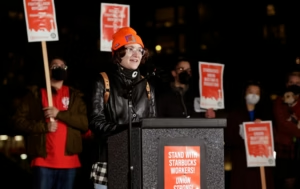
On the alienated roles of permanent protest the left uses to build party recruiting moments amongst enthusiastic, motivated young radicals, and then to train everyone in the habits of deference and obedience to a party line in the name of emancipation from hierarchical oppression, and such.
Props to Black Lodges for your support. Go sub to and support this superb blog if you like your critical analysis on point.

Cover: Microcultists explaining to the working class that emancipation necessitates a party line on imperialist war and genocide being bad, and habituating oneself to ideological conformity and groupthink as a first line of defense against bureaucratism and totalitarian police states.
Black Lodges || The crisis presently confronting Western political “counter” culture is no longer reducible to a deficit of awareness, but must instead be understood as a crisis of efficacy grounded in the structural limits of political action within advanced capitalist societies. It is not that populations remain uninformed; rather, there is an increasingly widespread recognition that the acquisition and circulation of knowledge, however extensive, does not in itself translate into material transformation.
Over several decades, successive waves of protest, petition, and public demonstration have sedimented into what may be described as an archive of dissent that is symbolically rich yet strategically impoverished. These forms of political expression, while occasionally even articulating moral clarity and generating visibility, have demonstrated a persistent inability to alter the underlying trajectories of power. Whether in relation to climate mobilisation, anti-war activism, or broader social justice movements, one encounters a recurring pattern: the production of spectacle without corresponding leverage, the articulation of outrage without institutional consequence, and the attainment of visibility without structural change. What is now emerging from this condition is not merely apathy, but a more unstable and politically consequential sensibility, namely, the growing apprehension that the dominant repertoires of dissent are themselves circumscribed by the very system they seek to contest.
This impasse is neither accidental nor contingent, but reflects the historically specific configuration of power within the capitalist state and its associated ideological apparatuses. One may understand contemporary Western societies as characterised by a form of hegemony in which consent is organised not merely through coercion, but through the incorporation and management of dissent itself. In this framework, protest does not necessarily function as an external challenge to power; rather, it is frequently internalised as a permissible and even necessary component of the system’s own reproduction. The liberal-democratic state, far from being destabilised by dissent as such, often demonstrates a remarkable capacity to absorb, reframe, and neutralise oppositional energies, thereby preserving the fundamental relations of production and the class structures upon which they rest.
The subjective experience of this structural condition is one of tension and indeterminacy. As individuals and movements begin to perceive the limited efficacy of established political forms, a space of uncertainty emerges, one marked by a search for alternative modes of action that are frequently inchoate and politically underdeveloped. It is precisely within this space that institutional actors, political organisations, and mediating bodies intervene with particular effectiveness, the No Kings Org come to mind specifically in the current climate. By channelling diffuse discontent back into familiar and highly regulated processes, most notably electoral participation, they are able to transform potentially disruptive energies into forms that are both legible and manageable within the existing order.
Elections are thus repeatedly framed as moments of existential significance, campaigns as sites of decisive intervention, and participation as an index of agency, even as the structural constraints governing policy and power remain largely unaltered. The cyclical pattern that results, wherein disillusionment gives rise to mobilisation, mobilisation to disappointment, and disappointment once again to managed forms of hope, can be understood as a key mechanism through which capitalist democracies reproduce their legitimacy. In this sense, the system does not require the absence of dissent; rather, it depends upon its continual renewal in forms that do not threaten its underlying foundations.
A further dimension of this problem lies in the historiography through which Western societies interpret their own traditions of resistance. The dominant narratives surrounding the anti-war movements of the twentieth century, for example in relation to the Vietnam War, are especially instructive in this regard. It is frequently asserted that mass protest within the United States and Western Europe exerted an influence on the termination of the conflict, such that public opinion, expressed through demonstrations, cultural production, and civil disobedience, is understood to have compelled the cessation of military intervention. This interpretation performs an important ideological function: it situates Western societies as ultimately self-correcting, capable of mobilising internal moral resources to restrain or reverse the excesses of their own state apparatuses. However, such an account risks obscuring the material determinants of the war’s outcome. The decisive factor in the defeat of the United States was not the transformation of opinion at the imperial centre, but the sustained and organised resistance at the periphery, most notably by the Viet Cong in conjunction with the North Vietnamese state.
To foreground this reality is not to deny that protest exerted any influence whatsoever; rather, it is to insist upon a more precise estimation of its role. Anti-war mobilisation may have contributed to shifts in the domestic political climate, may have imposed certain constraints upon strategic decision-making, and may have accelerated processes already underway within the state apparatus. Nevertheless, it did not constitute the primary determinant of the war’s conclusion. The conflict was brought to an end because it became materially and strategically untenable within the broader dynamics of imperialist competition and national liberation, not simply because it lost legitimacy within the societies prosecuting it. This distinction is of considerable theoretical and practical importance. Absent such clarity, contemporary movements risk overestimating their own capacity to effect change through symbolic or expressive means, while underestimating the structural conditions that delimit their action.
What emerges, therefore, is not a resolution but a deepening of the problem. If the dominant forms of protest are structurally constrained, and if prevailing historical narratives have tended to exaggerate their transformative power, then the question of political strategy must be reopened under far more exacting conditions. This entails a renewed engagement with the concepts of class struggle, state power, and the international division between core and periphery, as well as an examination of the organisational forms capable of mediating between consciousness and material force. The central difficulty lies in determining how political action might move beyond the level of symbolic resistance without being immediately reabsorbed into the circuits of hegemonic management that characterise contemporary capitalism. To pose this problem adequately is already to depart from the complacencies of liberal political thought; to resolve it, however provisionally, requires a level of theoretical clarity and organisational capacity that remains largely absent, which isn’t to say it is impossible to attain, on the contrary, but it remains a large chunk of the work to to be done.
This essay proceeds, therefore, from a position of impasse, treating it not as a paralysis to be lamented but as a condition to be analysed. Its aim is not to provide facile prescriptions, but to interrogate the structural limits of dissent in the contemporary West, to reassess the historical narratives that inform present understandings of political efficacy, and to explore the conditions under which forms of action capable of producing material change might emerge.
The Structural Limits of Dissent in Advanced Capitalist Societies
Any adequate analysis of dissent within the contemporary West must begin from the recognition that its apparent ineffectiveness is not merely a contingent failure of strategy, but is rooted in the structural properties of advanced capitalist states. Within the framework of Marxism, the state cannot be understood as a neutral arena within which competing interests are adjudicated, but rather as a historically specific condensation of class relations, as elaborated by Nicos Poulantzas. This implies that the institutional architecture of liberal democracy is already oriented towards the reproduction of capitalist social relations, even as it formally guarantees the right to dissent.
The permissibility of protest, therefore, should not be conflated with its efficacy. On the contrary, the incorporation of dissent into the normal functioning of the political system constitutes one of its defining features. One may observe that contemporary capitalist societies sustain themselves not solely through coercive apparatuses, but through the active organisation of consent. Dissent, insofar as it remains within recognised and regulated forms, marches, petitions, symbolic occupations, can be accommodated without threatening the underlying distribution of power. Indeed, such practices may contribute to the system’s resilience by providing a controlled outlet for discontent, thereby mitigating the risk of more disruptive forms of confrontation.
This dynamic has been further intensified under conditions of neoliberal restructuring. Neoliberalism has entailed not only a reconfiguration of economic policy, but a transformation in the modalities of governance and subjectivity. The individualisation of responsibility, the erosion of collective institutions, and the expansion of market logics into previously non-economic spheres have collectively undermined the organisational bases upon which effective dissent might be constructed. What remains is frequently a form of fragmented and episodic mobilisation, lacking the durability and strategic coherence necessary to exert sustained pressure upon state or capital.
At the same time, the proliferation of digital communication technologies has introduced new contradictions. While such technologies enable rapid dissemination of information and facilitate forms of networked mobilisation, they also tend to privilege immediacy over organisation, visibility over durability, and affective expression over strategic coordination. The result is a form of what might be termed ‘circulatory dissent’, in which political energies are continuously generated and dissipated within media circuits, without coalescing into forms capable of altering material relations. In this sense, the contemporary landscape of protest is characterised less by absence than by a paradoxical excess, an abundance of expression coupled with a scarcity of transformative capacity.
A second dimension of the problem concerns the spatial differentiation of political efficacy within the global capitalist system. Classical and contemporary theories of imperialism, from Vladimir Lenin to Samir Amin, have emphasised the hierarchical organisation of the world economy into core and periphery. Within this framework, advanced capitalist states occupy a privileged position, extracting value from the Global South through a variety of economic, political, and military mechanisms.
One consequence of this arrangement is that the decisive struggles shaping global outcomes frequently occur outside the metropolitan centres. Anti-colonial and national liberation movements in the Global South have historically exerted a far more direct influence upon the trajectory of imperial power than dissent within the core. This is not to suggest that metropolitan protest is irrelevant, but rather that its effects are mediated and often secondary to the material constraints imposed by resistance at the periphery.
Arab Marxist thought provides a particularly incisive perspective on this question. Writers such as Mahdi Amel have analysed the specificity of class formation within colonised and post-colonial societies, emphasising the articulation between internal class structures and external imperial domination. For Amel, the state in the periphery cannot be understood independently of its insertion into the global capitalist system; it is simultaneously a site of class struggle and a relay of imperial power. Similarly, Samir Amin’s concept of ‘delinking’ underscores the structural constraints that prevent peripheral societies from achieving autonomous development within the existing world order.
From this perspective, the tendency within Western discourse to centre its own forms of dissent appears as a form of ideological misrecognition. It attributes to the core a degree of agency that is, in practice, frequently exercised elsewhere. The historical experience of the Vietnam War, in which the defeat of a major imperial power was secured through sustained struggle in the periphery, constitutes a paradigmatic example. To the extent that Western movements interpret such events as the outcome of their own moral intervention, they risk reproducing a form of epistemic imperialism that mirrors the very structures they oppose.
The persistence of such misrecognition is closely linked to the ideological function of historical narrative. As Althusser has argued, ideology operates not merely at the level of explicit belief, but through the reproduction of the conditions under which certain interpretations appear natural or self-evident. In the context of Western protest movements, this involves the construction of narratives that emphasise the efficacy of dissent while downplaying its limitations.
The dominant account of the anti-war movement during the Vietnam War exemplifies this tendency. By foregrounding the role of protest in bringing about the end of the conflict, such narratives reinforce the belief that liberal-democratic societies possess an inherent capacity for self-correction. This belief, in turn, sustains continued investment in forms of political action that are compatible with the existing order, even when their empirical effectiveness is limited.
A more critical historiography would instead situate protest within a broader constellation of forces, including military dynamics, economic constraints, and the agency of actors in the Global South. It would recognise that while dissent may contribute to shifts in public discourse and elite calculation, it does not necessarily constitute the decisive factor in historical change. Such a reassessment does not entail a wholesale rejection of protest, but rather a reconfiguration of its place within a more complex and uneven field of struggle.
The capacity of Western political systems to absorb dissent must also be understood in relation to their broader mechanisms of social reproduction. Advanced capitalist societies are characterised by a dense network of institutions, educational, media, cultural, that function to reproduce not only labour power, but the ideological conditions necessary for the survival of the system. Within this context, dissent is often anticipated and pre-emptively managed, rather than simply repressed.
Moments of crisis, however, introduce a degree of instability into this process. Economic downturns, geopolitical conflicts, and ecological disruptions can all strain the mechanisms through which consent is organised. Under such conditions, the limits of established forms of dissent may become more apparent, as the gap between expressed demands and realised outcomes widens. Yet crisis does not automatically generate transformative change. As both Gramsci and later theorists have observed, periods of organic crisis are characterised by a proliferation of competing projects, not all of which are emancipatory.
In the absence of durable organisational forms and coherent political strategies, discontent may be redirected into channels that ultimately reinforce existing power structures. Populist movements, technocratic reforms, and intensified forms of electoral competition can all function as mechanisms for stabilising the system, even as they present themselves as responses to its failures. The management of uncertainty thus becomes a central task of contemporary governance, one that operates through both institutional and ideological means.
If the foregoing analysis suggests that the dominant forms of dissent in the contemporary West are structurally constrained, it does not follow that transformative action is impossible. Rather, it indicates that such action cannot be reduced to expressive or symbolic practices alone and the question of political efficacy is inseparable from that of organisation and material force.
Global Southern Marxist traditions offer important insights in this regard. From anti-colonial struggles in Africa and Asia to revolutionary movements in the Arab world, there has been a sustained emphasis on the necessity of linking political consciousness to concrete organisational forms capable of contesting state power and reconfiguring economic relations. While these experiences cannot be mechanically transposed onto the context of western capitalist societies, they nonetheless highlight the limitations of approaches that privilege spontaneity over structure or visibility over capacity.
At the same time, any consideration of future possibilities must reckon with the specific conditions of the present. The fragmentation of the working class, the integration of trade unions into institutional frameworks, and the globalisation of production all pose significant challenges to the formation of cohesive political subjects. Moreover, the international character of contemporary capitalism implies that struggles within the core are inextricably linked to those in the periphery, even when this connection is not immediately apparent.
The problem, therefore, is not simply to identify new tactics, but to rethink the relationship between dissent, organisation, and material power under contemporary conditions. This entails a shift from an understanding of politics as primarily expressive to one that is oriented towards the transformation of social relations. Such a reorientation cannot be achieved through abstract prescription; it requires sustained analysis, historical reflection, and practical experimentation.
The limitations of dissent in the contemporary West are not reducible to errors of judgement or deficiencies of will, but are rooted in the structural dynamics of advanced capitalism and the global system of which it forms a part. To confront these limitations requires not only a reassessment of historical narratives and ideological assumptions, but a rethinking of the very terms in which political efficacy is conceived. By situating Western protest within a broader, globally differentiated field of struggle, and by drawing upon the insights of Marxist traditions beyond the core, it becomes possible to move beyond both complacency and despair, towards a more rigorous engagement with the conditions under which meaningful transformation might occur.
Discover more from Class Autonomy
Subscribe to get the latest posts sent to your email.