Josh Olds || President Donald Trump, who campaigned on a platform of peace, announced in the middle of the night March 1 that he had initiated “major combat operations” against Iran called Operation Epic Fury. By morning, Trump claimed that these strikes had killed Iran’s supreme leader, Ayatollah Ali Khamenei.
Also, more than 80 children were killed in a U.S. strike that hit an all-girls elementary school adjacent to an Iranian military base. In an all-caps announcement on Truth Social, Trump proclaimed targeted strikes will continue until there is “PEACE THROUGHOUT THE MIDDLE EAST AND, INDEED, THE WORLD.”
Trump’s attack on Iran is not a new policy for the United States. In 1953, the CIA and British intelligence forces were instrumental in orchestrating a coup that deposed Iran’s democratically elected prime minister. The Western-backed monarchy was reinstated but that began a populist and nationalist pushback against the monarchy’s authoritarianism and Western world’s political interference that led to the 1979 Iranian Revolution. The monarchy again was deposed, this time replaced with an Islamic theocracy headed by Shiite Muslim clerics, creating the Islamic Republic of Iran.
That shift in Iran’s governance and culture — based on anti-Western sentiment — set the foundation for U.S.-Iran tensions to come. It also introduced a religious element to the tension, with the Muslim theocracy serving as a threat to “Christian” America and the Jewish state of Israel.
Prior to the Revolution, Israel and Iran enjoyed a mutually beneficial relationship, as did Iran and the U.S. Post-revolution, those relationships were severed with religious culture playing a key role in defining the conflict.

Apocalyptic theology
Today, while America’s relationship with Iran is influenced by all the typical geopolitical factors of oil, culture and nuclear weaponry, there is a part of American foreign policy that is influenced by apocalyptic evangelical theology. In the 19th century, theologian John Nelson Darby proposed that God relates to humanity through a series of distinct eras or “dispensations.” This dispensational theology spread quicky through the United States, reaching mainstream Christian audience with its promotion in the 1909 Scofield Reference Bible.
As part of his theology, Darby argued that Ezekiel 38 portrays a future war where nations will align themselves against Israel and God will bring judgment against them. Scofield took this claim and began to apply it to modern geopolitics, writing that “Russia and the northern powers have been the latest persecutors of dispersed Israel” and connecting the contemporary treatment of Jewish people in his day to end-times prophecy.
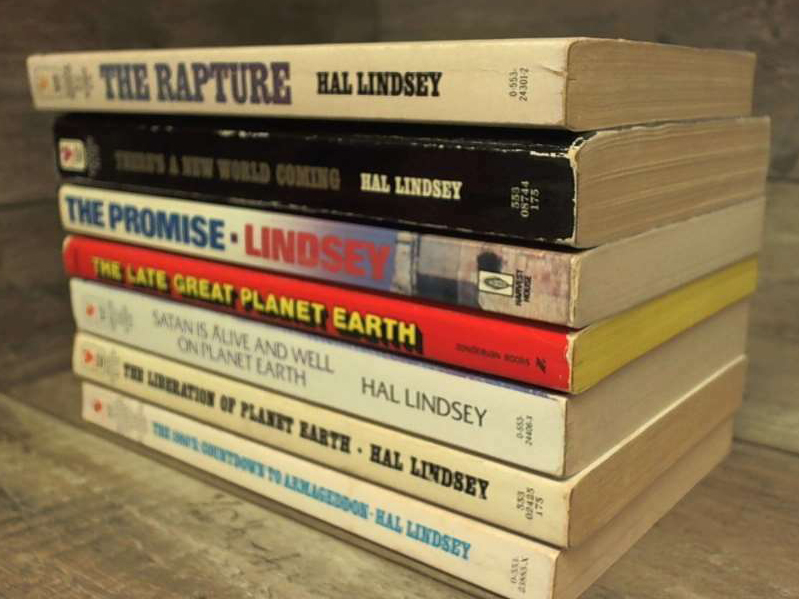
By 1970, this connection between ancient prophecy and modern nation-states had become entrenched, with Iran becoming an increasingly central figure. Hal Lindsey, writing in The Late Great Planet Earth, identifies every ancient nation in Ezekiel 38 with a modern nation.
While Darby and Scofield mentioned Iran in passing, Lindsey placed national Iran as an indispensable geopolitical ally: “All authorities agree on who Persia is today. It is modern Iran.” He explained how Russia requires Iran’s alliance to facilitate a land invasion of Israel.
Dispensationalist Tim LaHaye — author of the Left Behind novels that fictionalized dispensational eschatology — went one step further, suggesting in 1999 that Iran had purchased nuclear weapons from former Soviet-bloc countries following the collapse of the Soviet Union.
Iran to the center
This slow movement of Iran from the periphery of prophecy to central figure culminated in the work of Mark Hitchcock, who presents Iran as a central figure in end-times apocalyptic prophecy in several books, including Iran: The Coming Crisis, The Apocalypse of Ahmadinejad, Iran and Israel, and Showdown with Iran.

Iran and Israel begins with an extended passage from Yaakov Katz and Yoaz Hendel’s 2012 book Israel vs. Iran: The Shadow War imagining Israel launching a preemptive strike against Iran to prevent them from obtaining nuclear weapons. Hitchcock writes: “One thing is clear. If Israel launches a preemptive strike against Iran’s nuclear sites, things will never be the same. … The attack will trigger a cascade of events that could bring strong retaliation from Iran. … Such a war could spark a wider regional conflict, with Iran attacking American forces. … Some fear that an Israeli preemptive assault could even start World War III.”
He then asks a key question: “But is it possible that these events are part of a larger drama scripted long ago?”
Hitchcock envisions the conflict stemming from Israel’s preemptive assault will lead to the so-called War of Gog and Magog in Ezekiel 38. This war involves a coalition of enemies of Israel descending upon Israel to destroy it, but who are then miraculously destroyed by God. Writing in Showdown with Iran, Hitchcock says: “The current showdown with Iran strikingly foreshadows this coming war. What we see happening today is the perfect buildup. The specific countries and circumstances are converging with accelerating speed to take their prophesied places just as we should expect if this war is coming.”
And this is a war Hitchcock wants. In Iran: The Coming Crisis, he asks “How long will we wait to launch a preemptive attack to cripple Iran’s nuclear ambitions? How much longer can we wait?”
Longing for Rapture
For Hitchcock, the prospect of a conflict he believes could topple into World War III is a net positive because it brings the world closer to the Rapture — the imminent return of Jesus to take all Christians to heaven. In Hitchcock’s eschatology, the events of the War of Gog and Magog happen in the wake of the Rapture. He writes: “The prelude seems to be in place. All that remains is for the Rapture to take place.”
While the Rapture is perceived to be a thing that could happen at any time, Middle East tension is seen as a necessary precursor. Hitchcock writes that the United States has no presence in end-times prophecy because the American empire ends with the “immediate, sudden extraction of all the salt and light from the U.S.”
“The prelude seems to be in place. All that remains is for the Rapture to take place.”
In the power vacuum left by a Christian-less America, a world leader called the Antichrist will take power, which will lead to a period of suffering before Christ’s return called the Tribulation. This period is seen as one where God’s wrath is poured out on unbelievers before the final, eternal judgment.
American evangelicals look forward to the Rapture as a time of salvation and vindication. Hitchcock believes the Rapture will be “God’s final judgment on America” as it is forced to reckon with the loss of its Christian populace. “Add in the Rapture to all the other surging problems, and America will become a second-rate nation in the twinkling of an eye. The Rapture will change everything!”
With the Rapture, evangelical eschatology posits that folks finally get what they deserve: Christians are caught up to eternal bliss while non-Christians endure years of tribulation before final judgment. This desire for vindication and salvation — heaven for me and the wrath of hell for my enemies — is the driving impetus of evangelical eschatology. And it’s that type of thinking that is shaping American foreign policy.
Who’s apocalyptic now?
Perhaps what’s most ironic about Hitchcock and those like him is that they believe it is actually Iran that is operating foreign policy out of eschatology. In Iran and Israel, Hitchcock writes that Iran is driven by an “apocalyptic, genocidal ideology.”
He details Shiite Muslim eschatology as being characterized by a longing for the return of the Mahdi — a ninth-century religious leader whose return will usher in a worldwide Islamic caliphate. Quoting journalist Anton La Guardia, Hitchcock wonders if Iran’s leadership (then under Mahmoud Ahmadinejad) was trying to “influence the divine timetable” and “provoke chaos in the hope of hastening (the Mahdi’s) reappearance.” He says, “Iran’s politics cannot be divorced from its fundamental religious views.” Hitchcock has nothing to say about his own views fomenting the same chaotic apocalyptism.
Religion always will shape political imagination and policy. It is possible that Iran’s actions are fueled by apocalyptic expectation. But it is increasingly clear that American actions are shaped by it as well.
Donald Trump partnered with Israel to bomb Iran because of the influence of an eschatology that sees conflict with Iran as setting the stage for fulfilled prophecy. The irony is profound: A faith centered on loving enemies and making peace becomes a framework that welcomes and advocates violence. The result is not the advance of God’s kingdom but its irrevocable damage in the eyes of the world.
In evangelicalism’s attempt to usher in God’s kingdom on earth, they’ve actually missed it entirely.
Josh Olds is a public theologian and pastor for those disillusioned with institutional church. Follow his work on Facebook or at JoshOlds.com.
Discover more from Class Autonomy
Subscribe to get the latest posts sent to your email.