

After withstanding a decade of sanctions, Venezuela’s communes are prepared to face Trump’s illegal naval blockade and U.S. plans for economic asphyxiation.
Andreína Chávez, Drop Site News || CARACAS, Venezuela—Venezuela’s grassroots organizers and communards are responding with defiance and steadfast willingness to defend their country’s sovereignty in the face of U.S. President Donald Trump’s mid-December imposition of a “total and complete blockade” on Venezuela.
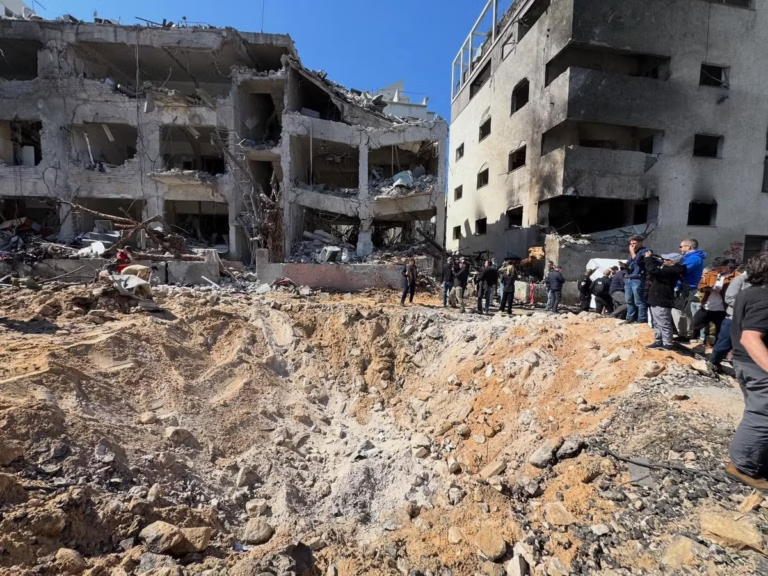
In an interview last Friday, President Trump said that the U.S. destroyed “a big facility” in Venezuela that Trump questionably claimed was engaged in drug trafficking. Last week’s operation would be the first known attack on Venezuelan land, and President Trump appeared to confirm the strike on Monday, saying “There was a major explosion in the dock area where they load the boats up with drugs,” he told reporters at Mar-a-Lago, his club and residence in Florida. “They load the boats up with drugs. So we hit all the boats, and now we hit the area. It’s the implementation area—that’s where they implement—and that is no longer around.”
This latest escalation comes as thousands of U.S. troops, warships, and combat aircraft have been deployed in the Caribbean since mid-August, just a few miles off Venezuela’s coasts. The U.S. blockade, based on claims made without credible sources or evidence, was deployed under a purported counter-narcotics mission against Nicolás Maduro’s government.
Trump also claimed in mid-December that the U.S. was entitled to “oil rights” in Venezuela, citing that U.S. companies ExxonMobil and ConocoPhillips had been “thrown out” of the South American nation almost two decades ago. In recent weeks, U.S. forces have seized three oil tankers in the Caribbean.
These actions were denounced by Caracas as illegal acts of maritime piracy carried out under unilateral sanctions lacking any basis in international law. The Maduro government called the seizures a “serious act of international piracy” as well as “blatant theft.” Each vessel was carrying approximately 1.8 million barrels of Venezuelan Merey-16 crude oil, and Trump has announced the U.S. would retain the cargoes.
“The U.S. has revealed to the world that its true intention has always been to plunder Venezuelan oil, land, and resources. However, we will not easily yield, and there is a unanimous determination to defend our homeland,” Lana Vielma, spokesperson for El Maizal Commune, a rural commune located between the Portuguesa and Lara states, told Drop Site News.
Venezuela’s communes are assembly-driven, constitutionally mandated, and grassroots political entities at the heart of the country’s socialist project. The communes contribute significantly to sovereign production and have become the backbone of the country’s political life.
In recent years, communes have set up economic circuits for the exchange of products and services they produce to support each other’s communities. These communal circuits offer a range of goods, including grains, vegetables, coffee, corn flour and textiles. In 2022, some communes came together under the “Hecho en Comuna” brand to distribute beyond their communities based on the principle of “life over capital.”
Vielma told Drop Site that the country is better prepared to withstand any form of economic sabotage than it was between 2017 and 2020, when it depended entirely on essential imports. Key imports such as foodstuffs were cut off by U.S. unilateral sanctions.
“We are not the same people we were five or ten years ago. Now we produce almost one hundred per cent of the food we consume,” said Vielma, who is also spokesperson for the Communard Union, which serves as an umbrella organization for Venezuela’s communal movement.
According to UN Special Rapporteurs’ data, the most significant impact of U.S. sanctions was malnutrition, with 2.5 million people suffering from food insecurity and 22 per cent of children under five experiencing stunted growth in 2019. The Centre for Economic Policy Research (CEPR) has documented the “negative effects on outcomes ranging from per capita income to poverty, inequality, mortality, and human rights” caused by sanctions.
Over the past decade, government and popular power initiatives like the communes have diversified the country’s economy, creating more sovereign production and distribution systems and eliminating the need for intermediaries. The country has become almost entirely self-sufficient as a result.
Hernán Vargas, spokesperson for Alba Movimientos and housing rights activist, condemned Trump’s “imperialist action” and expressed confidence that popular power has “armored” itself against U.S. economic sabotage, drawing from a decade of experience resisting sanctions.
The “Pueblo a Pueblo” Plan, created in 2015, is among the resistance mechanisms that became a lifeline during times of acute shortage and continues to operate today, feeding over 100 thousand children. The program connects rural producers directly with organized groups in urban areas, distributing fresh, affordable fruit and vegetables to schools nationwide.
“We now have diversification in the production of staples such as corn flour,” noted Vargas, referring to a Venezuelan staple that had been controlled by an oligopoly for decades and disappeared from the shelves during the worst years of the crisis. Now, numerous private, state-led, and communal producers ensure that a variety of products are available nationwide.
The Venezuelan communal movement has pledged to strengthen an economy centered on life and satisfying domestic needs, resolute in preserving sovereignty amid U.S. pressure. Vargas explained that the next challenge for the communal movement is to expand production to every corner of Venezuela through economic communal circuits, which encompass primary production, processing, supply, distribution, and consumption.
“While we condemn and express our outrage, we are also considering concrete action,” Vargas told Drop Site. “In recent years, we have secured production chains covering just over 80 percent of the nation’s main consumer goods. This capacity must be strengthened, and the primary challenge lies in integrating commune production into these distribution chains.”

U.S. Designs in The Caribbean
Since September, U.S. forces in the region have bombed small civilian vessels, killing more than 90 people in both Caribbean and Pacific waters, with U.S. officials claiming without evidence that they were carrying drugs. The strikes have been classified as extrajudicial killings by UN experts. UN data and the information from the U.S. Drug Enforcement Administration (DEA) show Venezuela is not a producer or main transit of either cocaine or fentanyl.
The Caribbean country is home to the world’s largest oil reserves, with over 90 percent of its foreign revenue coming from oil exports. Since 2017, Washington has imposed financial sanctions on the state oil company PDVSA, followed by an oil embargo in 2019 and other secondary measures in 2020. Crude production reached historic lows in 2020, leading to an economic downturn that experts described as the worst peacetime decline in modern history. Other key economic sectors—including banking, mining and essential imports—were also targeted, resulting in widespread shortages of food, medicine, and fuel.
Washington’s implementation of an illegal naval blockade on the country aims at further dissuading the commercialization of oil, the country’s most vital commodity, on international markets. Economists warn that these measures are aimed at starving the besieged nation of hard currency, severely impacting government finances.
Advocates of Washington’s campaign such as Ryan Berg, director of the Americas Program at the Center for Strategic and International Studies, had alleged that the U.S. was merely enforcing its sanctions policy and would only pursue “sanctioned” vessels. However, the second seizure of the Panamanian-flagged “Centuries” vessel, which was sailing under the Panama flag and is not under sanctions, indicates that Trump intends to enforce his “total and complete blockade” of Venezuela’s oil industry.
Legal experts view the seizure of the tankers and the naval blockade as an unprecedented measure of warfare that is tantamount to a unilateral declaration of war, violating principles of sovereignty and self-determination.
“The United States does not have the jurisdiction to seize a vessel, whether on high seas or in another country’s territorial waters,” Rubén Bolívar told Drop Site. Bolívar, a Venezuelan international and maritime law expert, specified that a vessel sanctioned by the U.S. Treasury Department’s Office of Foreign Assets Control (OFAC) does not mean it operates illegally or under a “shadow fleet,” as U.S. officials have claimed. The OFAC responds to U.S. foreign policy and does not adhere to the norm of applying sanctions through the UN Security Council or the wider UN system.
Bolívar warned that tankers not sanctioned by OFAC may avoid trading Venezuelan oil due to an “overcompliance effect.” According to reports, several tankers bound for the Caribbean country to deliver diluents or intending to pick up oil have turned back mid-route. Meanwhile, loaded vessels remain in Venezuelan ports over fears of seizure.
“The U.S. is no longer peddling the narrative of fighting drug trafficking. Trump has openly stated that the intention is to ‘reclaim’ the oil that he claims was stolen after Venezuela’s nationalization,” said Bolívar. He foresees that the narrative may soon change to a “transactional one” as the U.S. seeks to gain leverage against Caracas.
In 2007, ExxonMobil and ConocoPhillips chose to abandon their oil projects in Venezuela after refusing to transition to mixed-ownership with state majority control. Having first sought compensation through international arbitration, ConocoPhillips and other claimants may soon benefit from the auction of CITGO, the U.S.-based Venezuelan oil subsidiary seized in 2019 and worth billions.
The Maduro government has long denounced Washington’s oil-driven, regime-change agenda and decried the “narcoterrorism” claims as part of a manipulation campaign. In a recent statement, Caracas called the naval blockade a “grotesque threat” that exposes how Washington’s intentions have always been to appropriate the country’s resources.
“The U.S. president is seeking to impose an irrational naval blockade on Venezuela to steal the wealth that belongs to our homeland. We will never again be a colony of any empire,” read the communiqué. It also denounced the oil siege and militarization of the Caribbean Sea as a violation of the UN Charter and the right to free navigation and trade.
In response to Trump’s bellicose actions, Fuerza Patriótica Alexis Vive, a socialist self-defense collective from El Panal Commune in Caracas, affirmed the revolutionary grassroots organization’s ability to “sustain production, supply, communication, and collective protection, even in the most adverse conditions.” The organization said that Washington faces a “war of the entire people” in Caracas.
Discover more from Class Autonomy
Subscribe to get the latest posts sent to your email.