


Cover: Emma Goldman in Hyde Park, London, 1937. Via https://jwa.org/media/goldman-speaking-about-spanish-anarchists-at-may-day-rally-in-hyde-park-london-may-1-1937-phot
Sindicalismo.org via machine translation || The Social Revolution of 1936 was not just an event within the territories of the Spanish State. From the first days after the fascist coup, thousands of people from all over the world arrived on the Iberian Peninsula, convinced that a decisive battle for the future of Europe was being fought there. They did not come solely to fight fascism: many also came to defend a social revolution that demonstrated that another model of society was possible.
This proletarian internationalism, which for the first time acquired a massive dimension, left a profound mark on the history of the revolution. Books such as Papeles de Plomo , Viviendo la Revolución del 36 , and Viure la Força recover some of these international trajectories and show how men and women from very different backgrounds embraced a struggle they understood as universal.
When the revolution spoke all languages
Among those who answered the revolutionary call were workers, journalists, intellectuals, and activists from numerous countries. Papeles de Plomo (Lead Papers) reconstructs the participation of Uruguayan volunteers who traveled to Spain to fight fascism and support the revolutionary process. Their letters, articles, and testimonies reveal that the war and the revolution were experienced, even on the other side of the Atlantic, as a cause they themselves embraced.
Beyond their military involvement, these stories reveal the existence of an extensive international solidarity network built by trade unions, workers’ organizations, and libertarian groups that understood the defense of the Spanish revolution as part of the same struggle against the advance of fascism.
Tell the world about the revolution
Internationalism was also expressed through those who decided to document what was happening. Living the Revolution of ’36 recounts the experiences of Clara and Pavel Thalmann, Swiss journalists and activists who came to Barcelona drawn by the revolutionary process.

Their perspective combines political commitment with firsthand experience. They traveled along the front lines, lived alongside the militias, and closely observed the social transformations driven by the libertarian movement. At the same time, they disseminated their experiences internationally, becoming a bridge between the Spanish revolution and a European public opinion that followed the events with great anticipation.
His memoirs recall that the revolution was also fought in the field of information, against the simplifications and distortions that would soon begin to prevail.
Simone Weil and the search for a real revolution
Few figures better represent the intersection of thought and action than Simone Weil. In Viure la Força , Xavier Artigas reconstructs the philosopher’s time in revolutionary Spain and her joining the Durruti Column during the first months of the war.

Before going to the front, Weil wanted to see firsthand the collectivized factories, the workers’-controlled industries, and the peasant communities where libertarian communism was beginning to take shape. She wasn’t looking to confirm a theory, but rather to see to what extent it was possible to build a society based on equality and self-management.
His experience was brief, but profoundly transformative. The reflections that emerged from that journey constitute one of the most lucid testimonies on the possibilities and contradictions of the Social Revolution.
A shared struggle
Read together, these three books show that the 1936 Revolution was also an international experience. Thousands of people crossed borders to defend a political project they felt was their own, convinced that the fate of the Spanish revolution was linked to that of the world workers’ movement.
Ninety years later, their stories continue to remind us that internationalism was not an abstract slogan, but a concrete practice of solidarity among peoples. A conviction shared by those who understood that the fight against fascism and the construction of a more just society knew no borders.


When the Social Revolution of 1936 is remembered, narratives still often focus on leaders, militiamen, or large organizations. However, that history was also shaped by thousands of women who fought fascism, promoted emancipatory projects, and challenged power dynamics within their own organizations. Many of their experiences have been relegated to the background or simply excluded from official history.
Yanira Hermida’s book, *They Fought for a New World *, stems precisely from the need to recover this silenced memory. Through the lives of Lucía Sánchez Saornil and Sara Berenguer Laosa, the book reconstructs a genealogy of libertarian women who made their lives a form of activism and revolution a tool to conquer spaces of freedom that until then seemed unattainable.
The revolution was also a women’s issue
The work situates Lucía and Sara’s experiences within a long tradition of struggle for women’s emancipation within the libertarian movement. Long before 1936, anarchists like Teresa Claramunt had already denounced the subordination of women and defended the need for them to be the protagonists of their own liberation.
The arrival of the Republic and the growing participation of women in unions, cultural centers, and libertarian groups fostered new debates on education, sexuality, work, and personal autonomy. It was in this context that Mujeres Libres (Free Women) emerged, an organization that understood that social revolution and women’s emancipation had to advance together.
Lucía Sánchez Saornil: conquering a place of her own
To speak of Mujeres Libres is to speak of Lucía Sánchez Saornil. A poet, trade unionist, anarchist activist, and one of the organization’s founders, Lucía embodied a form of commitment that challenged both the capitalist order and the patriarchal inertia present within the libertarian movement itself.

Her writings insisted that women’s emancipation could not be subordinated to a future revolution, but rather had to be built in the present through education, economic independence, and active participation in social and political life. She also championed a progressive view of sexual freedom and openly lived her lesbianism at a time when doing so represented a radical challenge to social norms.
Sara Berenguer Laosa: the revolution from everyday action
If Lucía represents the theoretical and organizational development of anarcho-feminism, Sara Berenguer Laosa embodies a whole generation of young women who joined the revolutionary struggle from July 1936 onwards. Her time with Mujeres Libres led her to become aware of the inequalities suffered by women even within spaces that proclaimed themselves egalitarian.
From then on, she participated in educational activities, solidarity networks, rear-guard tasks, and visits to the front organized by International Antifascist Solidarity. Like so many other activists, she combined revolutionary action with intense work in mutual support and collective organization.

Her trajectory demonstrates that the revolution was not only built on the barricades or in the committees, but also through the daily work of thousands of women who sustained organizations, care networks and social transformation projects.
Recovering an incomplete story
Ninety years later, They Fought for a New World reminds us that the 1936 Revolution cannot be understood without the women who made it possible. The lives of Lucía Sánchez Saornil and Sara Berenguer Laosa offer a glimpse into a history of emancipation, commitment, and resistance that remained on the margins for far too long.
Recovering their voices does not mean adding a forgotten chapter to the history of the revolution. It means understanding that that history was always incomplete without them.


The history of the Civil War and the Social Revolution of 1936 is made up of hundreds of thousands of personal experiences. Stories written in small print, far removed from grand speeches and well-known figures, but lived firsthand by those who chose to confront fascism and build a different society.
From our beginnings at Descontrol Editorial, we have sought to recapture that perspective. Not only that of those who conceived or led the revolution, but also that of those who lived it day by day, participating in collectivizations, organizing educational projects, or fighting on the front lines. Books such as Agustín Souchy’s * Among the Peasants of Aragon *, Félix Carrasquer’s * The School of Militants of Aragon *, and Ricardo Sanz’s * Those of Us Who Went to Madrid * allow us to approach the revolution from the direct experience of its protagonists.
When utopia became reality
In Among the Peasants of Aragon , the German anarcho-syndicalist Agustín Souchy travels through the Aragonese villages that, after the defeat of the military coup of July 1936, began to put into practice an unprecedented experience: the collectivization of the land and the construction of libertarian communism.
Souchy does not write as a detached observer. Linked for decades to the international labor movement, he visits the collectives to learn firsthand how thousands of peasants were organizing production and daily life without bosses or large landowners. His testimony is especially valuable because it shows how what had been considered a utopia for years became a tangible reality.

Educating to transform society
The revolution didn’t unfold solely in factories, fields, or trenches. It was also forged in spaces of training and learning. Félix Carrasquer’s School of Militants in Aragon recovers a unique educational experience born in the midst of war.
More than just an educational project, the school was an attempt to train people capable of actively participating in a self-governing society. Carrasquer describes a process that combined education, social reflection, collective organization, and revolutionary commitment.
War as seen from the trenches
While Souchy and Carrasquer depict the revolution behind the lines, * Those of Us Who Went to Madrid* places us on the front lines. Ricardo Sanz, a prominent CNT militant and leader of the Durruti Column, recounts his wartime experiences from the perspective of those who fought directly against the rebel army.
In this book, Sanz recounts what he saw and experienced alongside the militiamen and combatants of the 26th Division. His account allows the reader to follow the evolution of the anti-fascist militias, the political tensions within the Republican camp, and the difficulties of a war that many understood as inseparable from the social revolution itself.

The book’s strength lies precisely in that direct perspective. It is not the story of great strategists or political leaders, but rather the story of those who occupied the trenches and experienced firsthand the hopes, contradictions, and defeats of that historical process.
Understanding the revolution from below
Read together, these three books offer a privileged perspective on the 1936 Revolution. They do not aim to construct grand theoretical interpretations, but rather to show how those who participated in that moment experienced it.
Ninety years later, these testimonies still retain a singular power. They bring us closer to the everyday reality of the revolution and remind us that great historical processes are made up, above all, of small stories lived by ordinary people who, in extraordinary circumstances, decided to take their collective destiny into their own hands.


When discussing the Social Revolution of 1936 , one often recalls the militias, the barricades, and the political fervor of the first months of the war. But one of the most profound and unique transformations of that process occurred in the economic sphere: the collectivization of factories, workshops, transportation, services, and agricultural land by organized workers.
Following the defeat of the fascist coup of July 19th in Catalonia, the flight or disappearance of many employers and the momentum of the unions (especially the CNT) created an unprecedented situation. Thousands of workers began to directly manage production and services, putting into practice forms of self-management that until then had been primarily a political and trade union ideal.
Several books in our catalog allow us to approach that experience from complementary perspectives.
Organizing a new economy
The Collectivization Decree of October 1936 attempted to give legal form to a revolutionary reality that already existed in the streets and workplaces. Drafted under the Catalan Government’s Ministry of Economy, headed by the CNT member Joan Pau Fàbregas, the decree recognized workers’ control over many companies and established mechanisms for collective management.
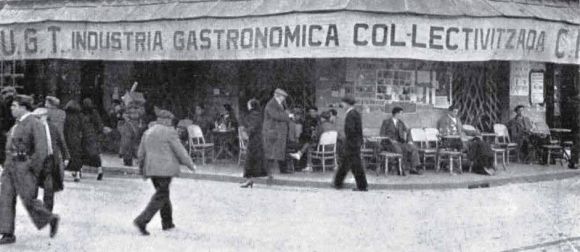
Far from being an improvised project, the economic revolution was preceded by decades of debate within the libertarian movement about how to replace capitalism with a social organization based on cooperation and mutual support. In Els factors econòmics de la revolució (The Economic Factors of the Revolution) , Fàbregas argues precisely for the need for a workers’-coordinated economy, capable of overcoming the inequalities of the capitalist system and simultaneously withstanding the difficulties imposed by the war.
This transformation, however, unfolded amidst constant tension. On one side, workers’ committees were promoting new forms of production and distribution; on the other, the Generalitat (with ERC and PSUC gaining influence) was attempting to regain institutional control of the economy and limit the revolutionary scope of the process.
The everyday revolution
While Fàbregas’s texts reveal the political and organizational dimensions of the collectivizations, Félix Carrasquer’s * Las colectividades de Aragón* (The Collectivities of Aragon ) allows us to see their human and everyday dimension. The book describes how dozens of Aragonese villages abolished private land ownership and reorganized collective life on an assembly-based basis.
The collectives not only transformed agricultural production; they also modified social relations, education, and consumption patterns. In many cases, communal dining halls, rationalist schools, and distribution systems based on need were created. The revolution was taking shape in daily life.

Carrasquer also shows the contradictions and difficulties of the process : the scarcity, the military pressure, the political disagreements and, finally, the repression promoted by the republican authorities against many self-management experiences.
Thinking about the revolution
In *The Economic Organism of the Revolution *, Diego Abad de Santillán presents a broader reflection on how a revolutionary economy should be organized. The anarchist leader defended the need to coordinate production and distribution on a large scale without reproducing state structures or bureaucratic hierarchies.
The central debate was: how to reconcile self-management and economic efficiency? How to sustain a war without abandoning revolutionary objectives? How to prevent institutionalization from ultimately deactivating the momentum born in July 1936?
These questions also run through books such as 80 dies al govern de la Generalitat or Les finances de la Revolució , where Joan Pau Fàbregas recounts the tensions between the revolutionary power that emerged from the unions and the progressive reconstruction of state authority.
A unique experience
The collectivizations of 1936 constituted one of the most important experiences of worker self-management in the 20th century . Despite the limitations, the war, and the ultimate defeat, for months thousands of people demonstrated that it was possible to manage factories, transportation, or agricultural land without bosses.
Today, these works allow us to recover not only the memory of that process, but also the debates that made it possible. Reading them is to return to a time when revolution was not an abstraction, but a daily practice built from workshops, cooperatives, and assemblies.


On the 90th anniversary of the Spanish Social Revolution , revisiting the specific lives that made it possible is not only an exercise in memory, but also a way to rethink that process from a human perspective. Forgotten Enthusiasts , coordinated by Miquel Izard , and Biographies of ’36 , coordinated by Paolo Casciola and Agustín Guillamón , share this objective: to rescue personal trajectories that allow us to understand the revolution beyond the grand narratives.
Both works start from the same premise: the history of 1936 cannot be explained solely through leaders or events, but requires attention to the (often invisible) biographies of those who starred in it.
The enthusiasm that transformed lives
Forgotten Enthusiasts focuses on those who experienced the “libertarian summer” as a profoundly transformative event, but who have been left out of historical memory. Izard situates this moment within the clash between reactionary forces and the expectations opened up by the Republic, emphasizing how the coup of July 1936 unleashed a revolution that, in places like Catalonia, altered productive, educational, and social structures.
This process involved thousands of people who discovered their capacity for intervention. The biographies gathered here reflect this diversity: from the educator Margarita Wirsing , committed to emancipatory education even in the face of repression, to the worker Eugenio Vallejo , a key figure in the industrial reorganization during the war and who disappeared in exile. Alongside them, figures like Ferran Cardona demonstrate the continuity between technical and political commitment in revolutionary contexts.
The book thus champions a collective history, built from concrete and often forgotten experiences.

Barcelona as an international crossroads
Biographies of ’36 broadens its perspective to include an international dimension. It brings together profiles of revolutionaries, exiles, and stateless persons who converged in Spain (especially in Barcelona) during the war. Many were foreign activists who saw in the revolution an opportunity to fight fascism.
Among them stand out trajectories such as that of Kurt Landau , transformed by his Barcelona experience, or that of Albert Masó , who embodies the intersections of militancy, repression, and exile. Their lives, along with many others, reveal networks of political and personal relationships that bear witness to the intensity of the revolutionary moment.

Restore the human population density of 1936
Read together, both books offer complementary perspectives: one from the perspective of everyday, local experience; the other from its international dimension. In both cases, the objective is the same: to combat oblivion and restore prominence to those who lived through and fought during that time.
On this anniversary, these works invite us to look at 1936 from below, through concrete lives that made it possible to imagine (and for a time, practice) a different world.


