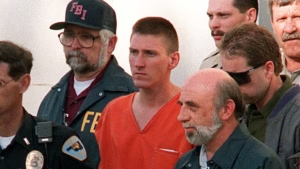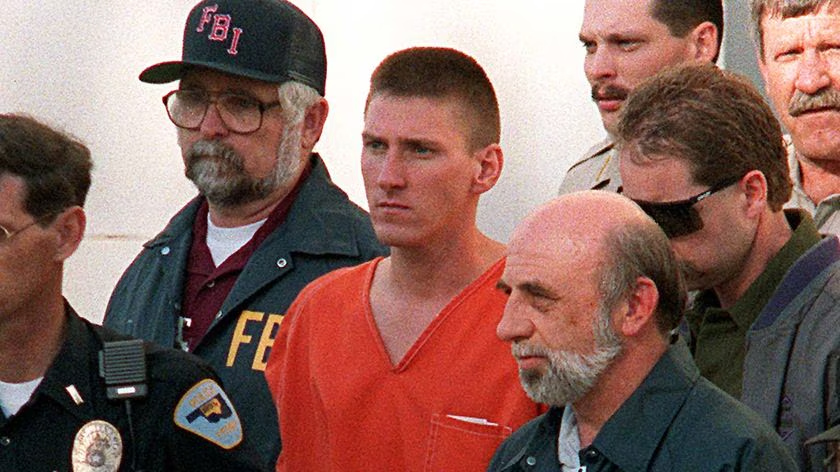
Caroline Mala Corbin, University of Miami School of Law || When you hear the word “terrorist” who do you picture? Chances are, it is not a white person. In the United States, two common though false narratives about terrorists who attack America abound. We see them on television, in the movies, on the news, and, currently, in the Trump administration. The first is that “terrorists are always (brown) Muslims.” The second is that “white people are never terrorists.
Different strands of critical race theory can help us understand these two narratives. One strand examines the role of unconscious cognitive biases in the production of stereotypes, such as the stereotype of the “Muslim terrorist.” Another strand focuses on white privilege, such as the privilege of avoiding the terrorist label.
These false narratives play a crucial role in Trump’s propaganda. As the critical race analysis uncovers, these two narratives dovetail with two constituent parts ofpropaganda: flawed ideologies and aspirational myths. Propaganda relies on preexisting false ideologies, which is another way to describe racist stereotyping. Propaganda also relies on certain ideals and myths, in this case, the myth of white innocence and white superiority. Thus, the Trump administration’s intentional invocation of both narratives amounts to propaganda in more than just the colloquial sense.
Part I illustrates each of the two narratives. Part H1 then analyzes them through a critical race lens, showing how they map onto two strands of critical race theory. Next, Part III examines how these narratives simultaneously enable and constitute propaganda. Finally, Part IV argues that the propagation of these false narratives hurts the nation’s security.
Caroline Mala Corbin, Essay: Terrorists Are Always Muslim but Never White: at the Intersection of Critical Race Theory and Propaganda, 86 Fordham L. Rev. 455 (2017).
https://www.youtube.com/watch?v=uN9o4pxEHx0
A few years back, many politicians were raising the alarm about the dangers of “CRT” in schools. Today, the new risk to public education is “DEI.” What do both of these moments have in common? They have all the elements of a moral panic. So in this installment of Code Switch History Class, we’re looking at the history of moral panics in the U.S., and why they so often invoke fears about race and integration.
Discover more from Class Autonomy
Subscribe to get the latest posts sent to your email.